International Buyers Guide 2025
90,00 €
Purchasing real estate in France as a foreign buyer comes with unique opportunities—but also complex legal, financial, and tax considerations. Our International Buyer’s Guide 2025 provides expert insights to help you navigate every stage of the process with confidence.
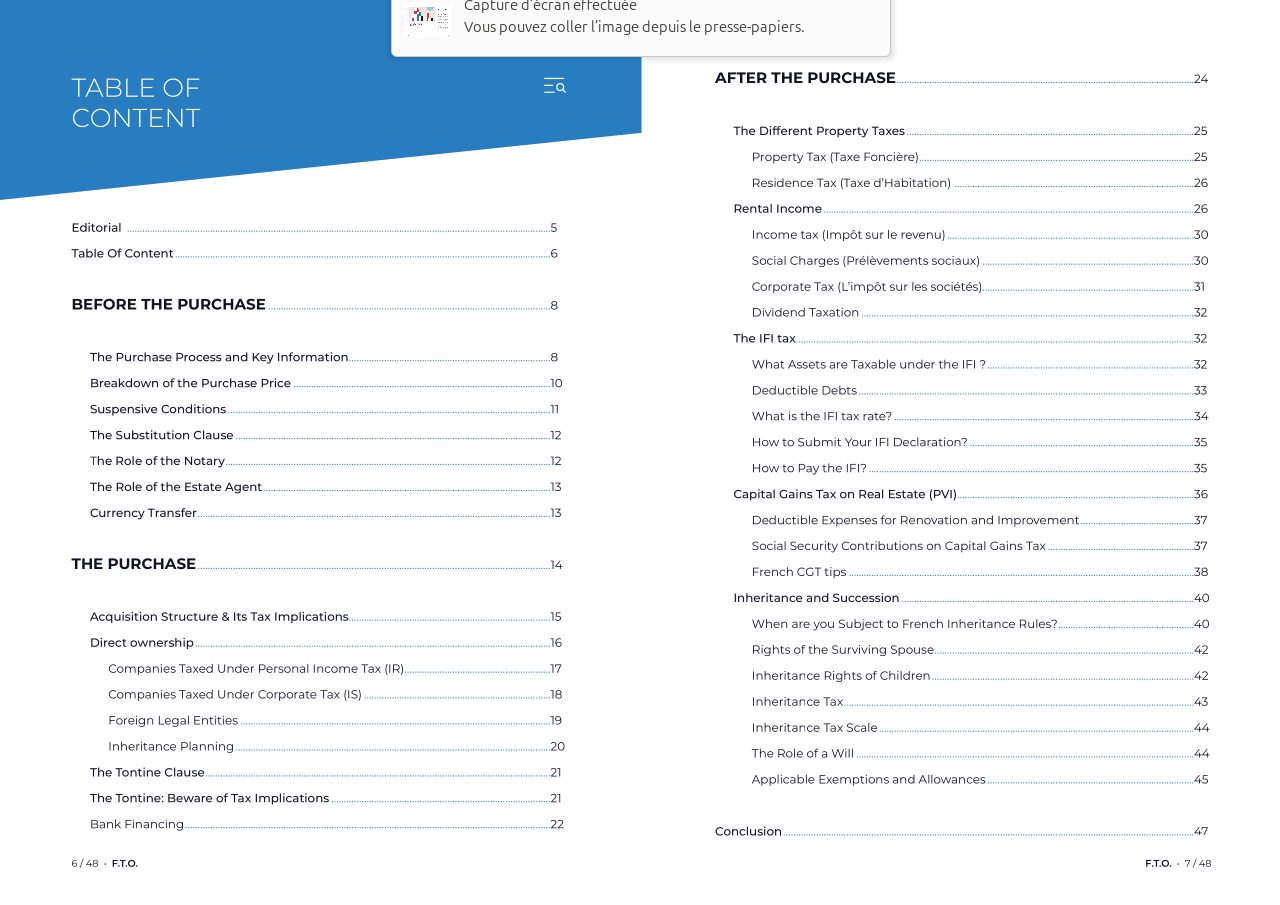
 Before the Purchase – Understand key legal terms, the role of the notary and estate agent, and the financial aspects of acquiring property.
The Purchase Process – Learn about acquisition structures, tax implications, and financing options to optimize your investment.
After the Purchase – Get clear guidance on property taxes, rental income taxation, capital gains tax, and wealth tax (IFI).
Inheritance & Succession Planning – Ensure your property is protected with strategies for inheritance tax, wills, and estate planning.
This comprehensive guide is designed for international buyers who want to avoid pitfalls, reduce tax burdens, and make informed decisions when investing in French real estate.
 Download your copy today and invest in France with confidence!
Description
International Buyer’s Guide 2025 – Your Ultimate Resource for Buying Property in France
Purchasing real estate in France as an international buyer is an exciting opportunity—but it can also be a complex and overwhelming process. With differences in tax laws, legal structures, and administrative requirements, navigating the French property market requires careful planning and informed decision-making.
That’s why we’ve created the International Buyer’s Guide 2025—a comprehensive, step-by-step resource designed to give you the knowledge and confidence to purchase property in France successfully. Whether you’re buying a holiday home, an investment property, or planning to relocate, this guide covers everything you need to know.
Why Do You Need This Guide?
 Understand the Legal Process
French property law differs significantly from other countries. We explain the roles of key professionals such as notaries and estate agents, the importance of suspensive conditions, and legal clauses that can impact your purchase.
Make Informed Financial Decisions
Buying property is a significant investment, and structuring your purchase correctly can save you thousands in taxes. The guide breaks down the full cost of acquisition, from the purchase price to notary fees, and explains the different ownership structures (personal, corporate, or foreign legal entities) and their tax implications.
Avoid Common Pitfalls
Many international buyers make costly mistakes due to a lack of knowledge about French property law and taxation. We highlight the key risks—such as unexpected tax liabilities, inheritance issues, and financing challenges—so you can avoid costly surprises.
Plan for Taxes & Future Obligations
Owning property in France comes with ongoing financial responsibilities. This guide provides clear explanations of property taxes (Taxe Foncière, Taxe d’Habitation), rental income taxation, corporate tax options, wealth tax (IFI), capital gains tax, and social security contributions.
Secure Your Investment for the Future
France has specific inheritance laws that can impact how your assets are passed down. Our guide explains succession rules, inheritance taxes, the role of a will, and how to protect your family’s interests through strategic planning.
What’s Inside the Guide?
 Before the Purchase – Understanding the key steps, legal considerations, and financial planning.
The Purchase Process – A complete breakdown of contracts, pricing, and tax-efficient ownership structures.
Financing & Currency Exchange – Explore mortgage options for non-residents and best practices for currency transfers.
After the Purchase – Managing ongoing taxes, rental income, and tax-efficient property management.
Inheritance & Succession Planning – How French inheritance laws impact your estate and what steps you should take.
Watch Our Video for More Insights! 

We also break down key topics in our video guide! Watch it here:
 International Buyer’s Guide – Video Overview
Download Your Copy Today!
Whether you’re a first-time buyer or a seasoned investor, the International Buyer’s Guide 2025 is an essential resource for anyone looking to buy property in France. Avoid unnecessary risks, minimize tax burdens, and invest with confidence.
Get your guide now and start your journey to owning property in France!
Who Is This Resource Designed For?
This 2025 edition is tailored for international buyers who want more than surface-level information.
It is particularly relevant for:
- Non-residents acquiring property in France
- UK, US, Swiss, and EU investors entering the French real estate market
- Expats preparing for relocation or applying for a long-stay visa
- Families purchasing a second home in Paris, Provence, the South of France, Bordeaux, Lyon, or other sought-after regions
- Investors focused on rental income and long-term capital appreciation
- High-net-worth individuals concerned about wealth tax (IFI) exposure and succession structuring
Whether your objective is a primary residence, holiday property, lifestyle relocation, or income-generating investment, this publication provides the legal and tax clarity required before making a binding commitment.
What Sets This Apart?
This is not a generic property overview or lifestyle blog.
It has been developed by chartered accountants and international tax specialists who advise foreign buyers investing in France every day. The content reflects real transactions, real tax filings, and real-world structuring decisions.
It combines:
- Clear explanations of French legal mechanics
- Tax optimisation frameworks
- Practical examples and numerical illustrations
- Structured decision-making guidance
- Risk analysis tailored specifically to non-residents
Rather than simply describing how to buy property in France, it explains how to structure your purchase correctly — from a tax, asset protection, and wealth-planning perspective.
Key Areas Covered in Depth
1) The French Property Acquisition Process
Buying property in France follows a structured legal pathway that differs significantly from Anglo-Saxon systems. Understanding each stage is essential to avoid unintended commitments or financial exposure.
This section walks you through the full acquisition timeline:
- Offer to purchase (offre d’achat) – when it becomes binding and under what conditions
- Compromis de vente (preliminary sales agreement) – legal effects, deposit obligations (typically 5–10%), and enforceability
- 10-day cooling-off period – how it works and when it starts
- Suspensive conditions – mortgage approval, planning permission, administrative authorisations
- Substitution clauses – flexibility to change purchasing structure before completion
- Signature of the final deed (acte de vente) – transfer of ownership and payment mechanics
- The legal role of the notary – escrow management, verification of title, compliance checks
- The advisory role of the estate agent – valuation guidance, negotiation dynamics, local market intelligence
International buyers frequently underestimate the legal force of the preliminary agreement. In France, once the cooling-off period has expired, withdrawing without valid suspensive conditions can result in losing 10% of the purchase price.
This section ensures you understand not only the sequence of events, but the legal consequences attached to each stage.
2) True Acquisition Costs & Financial Planning
The advertised price rarely reflects the total financial commitment required.
This part provides a comprehensive financial breakdown so you can assess the real purchase cost, including:
- Notary fees (approximately 2–3% for new properties and 7–8% for older properties)
- Registration taxes and state duties
- Agency fees and how they are allocated between buyer and seller
- VAT considerations for new developments or specific rental schemes
- Furniture valuation strategies that may reduce transfer taxes
- Bank financing costs and collateral requirements for non-residents
- Currency exchange optimisation strategies for UK, US, Swiss and other non-euro buyers
For large transactions, currency mismanagement alone can cost tens of thousands of euros.
By understanding the full cost structure upfront, you gain stronger negotiation leverage and avoid liquidity surprises at completion.
3) Selecting the Appropriate Ownership Structure
How you acquire the property is often more important than the property itself.
This section provides a structured comparison of the main acquisition vehicles:
- Direct ownership (in your personal name)
- SCI taxed under income tax (IR)
- Company subject to corporate tax (IS)
- Foreign legal entity ownership
For each structure, we analyse the implications for:
- Rental income taxation
- Social charges exposure
- Depreciation possibilities
- Capital gains treatment upon resale
- Exposure to wealth tax (IFI)
- Dividend taxation (for corporate structures)
- Inheritance transmission and valuation mechanics
While certain structures may appear attractive due to short-term tax benefits, they can create significant disadvantages upon resale or personal use of the property.
A poorly chosen structure may increase your effective tax burden, complicate succession, or trigger benefit-in-kind taxation.
4) Rental Income & Ongoing Taxation
If you intend to generate rental income, French tax rules become highly technical — especially for non-residents.
This section provides clarity on:
- Furnished vs. unfurnished rental regimes
- Micro vs. real taxation methods and eligibility thresholds
- Non-resident income tax brackets and minimum rates
- Social security contributions (17.2% or 7.5%) depending on residency status
- Corporate tax scenarios for IS structures
- Dividend taxation mechanics
- Professional vs. non-professional furnished rental classification
French taxation of rental income combines income tax and social charges, which can significantly affect net profitability.
With proper modelling and regime selection, it is possible to optimise net returns and avoid overpaying tax.
5) Wealth Tax (IFI)
France replaced its former wealth tax with a real estate-focused wealth tax: IFI (Impôt sur la Fortune Immobilière).
If the net value of your French real estate exceeds €1.3 million, you may fall within scope.
This section explains in detail:
- Which assets are included in the IFI base
- How indirectly held property (via companies) is assessed
- Which debts are deductible and under what conditions
- Anti-abuse limitations on excessive debt deduction
- Applicable progressive tax rates
- Filing deadlines and payment obligations
- Structuring considerations for high-value portfolios
This is particularly relevant for buyers acquiring premium properties in Paris, the South of France, or other prime markets.
Failure to anticipate IFI exposure can create unexpected annual tax liabilities.
6) Capital Gains Tax on Resale
Resale taxation should be considered from the moment you purchase.
French capital gains tax (CGT) for individuals consists of:
- 19% income tax component
- 17.2% (or 7.5%) social contributions
This section explains:
- How taxable gains are calculated
- Flat-rate vs. actual deduction options for acquisition costs
- Renovation and improvement expenses eligible for deduction
- Holding period allowances (full exemption after 22 years for income tax and 30 years for social charges)
- Surtaxes on high capital gains
- Tax representative obligations for non-residents
Strategic documentation and expense tracking during ownership can significantly reduce future capital gains exposure.
7) Inheritance & Succession Considerations
French succession law operates under forced heirship principles, which can conflict with common-law estate planning traditions.
This section addresses:
- The concept of the hereditary reserve
- Rights of the surviving spouse
- Usufruct vs. full ownership options
- The progressive inheritance tax scale
- Article 750 ter implications for non-residents
- Double-tax treaty considerations
- Allowances (e.g., €100,000 per parent per child every 15 years)
- The importance of drafting an appropriate French or cross-border will
Without advance planning, French inheritance law may override foreign wills or estate expectations.
For international families, coordination between jurisdictions is essential to preserve both tax efficiency and family intentions.